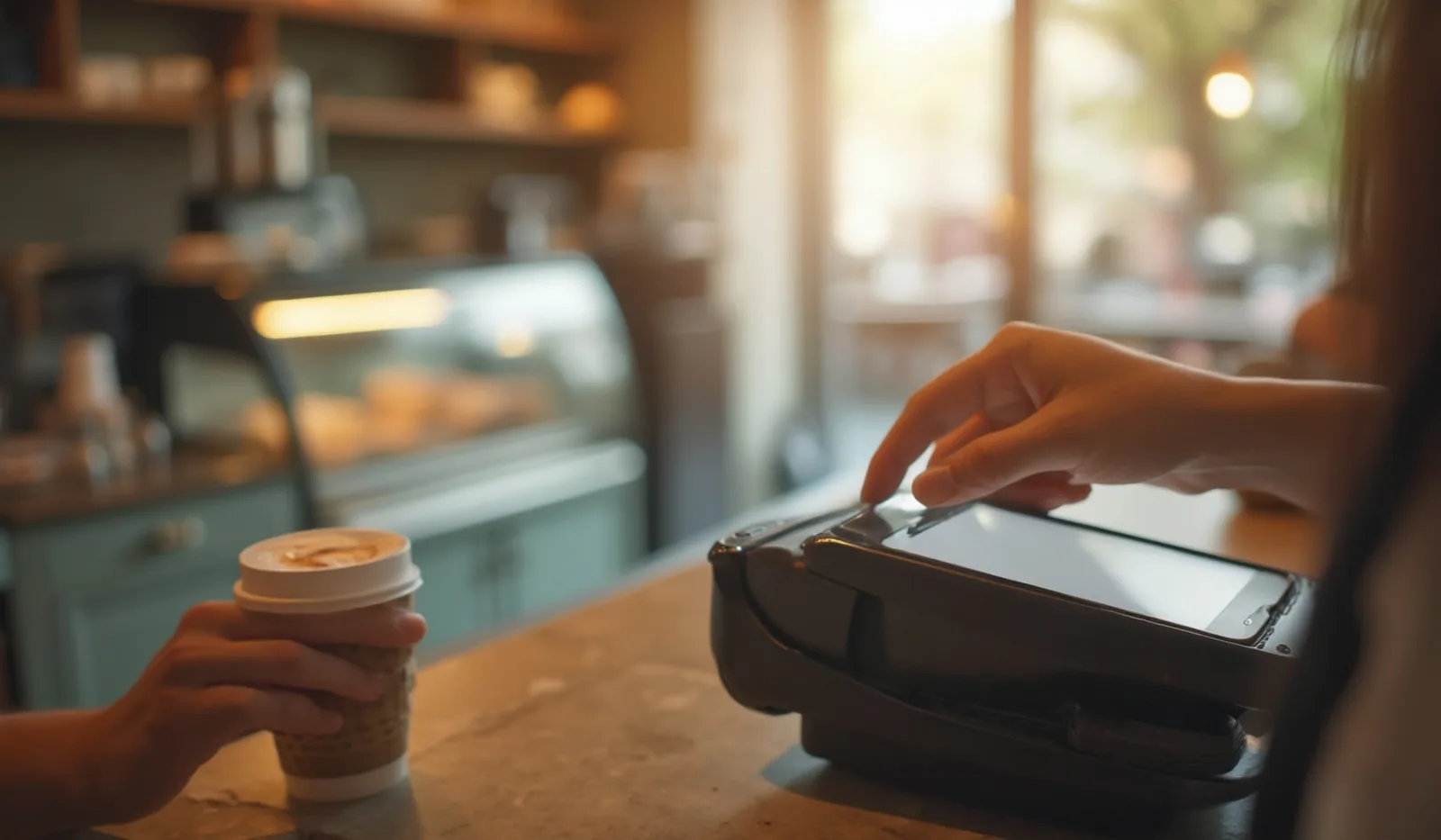
You hold your phone or card near the little screen, it beeps, and the total's gone — no PIN, no signature, most of the time not even a swipe. That speed is exactly why tap-to-pay feels less serious than the methods it replaced, like a trick the store is letting you get away with rather than a full financial transaction. It's a full transaction. It's just running on newer, and in some real ways more careful, plumbing than a swipe or a chip insert ever did.
None of that plumbing is a mystery once you know where to look. Once you can see what actually leaves your card or phone in that half-second, the spending limits you'll eventually bump into and the surprisingly good news about a lost phone stop feeling like fine print and start feeling like features.
What's actually happening in that half-second tap
A tap runs on a short-range radio conversation called near-field communication, or NFC — a tiny chip in your card or phone talking to a matching chip in the terminal, close enough that you could hold a coin between them. That short range is the whole point: it's why you have to get within an inch or two before anything happens, and why nobody's card is quietly charging from across a checkout line.
What gets said in that conversation isn't your account number. Instead of handing over the same digits printed on the front of your card, the chip generates a one-time code — cryptographically signed, tied to this specific purchase, this specific terminal, this specific moment — and sends that instead. Your bank checks the code, confirms it's genuine, and approves the charge, all without the raw number ever crossing the air between your card and the register.
Why a tap is safer than a swipe or a chip insert
That one-time code is also why a tap beats the two payment methods it's replacing, not just in speed but in actual exposure. A magnetic swipe reads the same static number off the stripe every single time — which is exactly why a cheap skimmer clipped onto a gas pump or an ATM can copy it once and reuse it indefinitely. A chip insert improved on that by generating a fresh code per transaction too, but it does it slowly enough — several seconds of contact — that a hidden reader positioned close to the slot has a real window to also lift the static number stored deeper on the chip.
A tap shrinks that window to a fraction of a second, with no exposed metal contact at all. And on a phone or watch, there's an extra layer underneath: when you add a card to a device's wallet, the wallet never actually stores your real account number on the device. It requests a stand-in number from your bank instead — one that's tied specifically to that device's own security chip and useless anywhere else. Even a total, perfect intercept of everything a tap transmits hands a thief a number that already can't be reused for a second purchase, on a second device, or anywhere but the terminal it was generated for.
The dollar limits you'll eventually bump into
Most taps sail through with no PIN, signature, or phone unlock at all — and that's not your bank being careless, it's a deliberate trade card networks built on purpose. Below a set ceiling, the system accepts a small amount of unverified risk in exchange for speed, on the logic that even a stolen card or phone can only do so much damage at that scale. Cross the ceiling, and the terminal falls back to asking for real proof it's you: a PIN, a signature, or your phone's own unlock step — the same checks a chip insert has always required.
That ceiling isn't fixed everywhere. A transit turnstile or a vending machine might set it lower, or skip the check entirely for the smallest purchases, calibrated to how little there is to lose if that specific tap turned out to be fraudulent. It's not a loophole to route around — it's the system quietly matching how much checking a purchase is actually worth.
What losing your phone doesn't mean anymore
A lost physical card used to mean a real gap: whoever picked it up off the sidewalk could use it for anything short of a signature match, right up until you noticed it missing and called to cancel — and canceling meant a new number, a new physical card in the mail, and resetting every subscription and autopay tied to the old one.
A lost phone or watch works differently, because the tap token behind it sits behind the device's own lock screen first. A thief has to defeat that lock before the tap even fires — something a found plastic card never asks of anyone. And if the device is genuinely gone, you can revoke just that device's token remotely, from another device or a browser, in minutes, without touching the physical card number at all. Every other card and device tied to the same account keeps working exactly as before.
The one habit that matters more than the technology
Because the mechanics genuinely resist skimming and copying, what's left for you to manage is smaller than it feels — but it's still worth doing on purpose:
- Glance at the total before you tap. The tap protects the number underneath, not the number on the screen — a terminal charging the wrong amount is a math problem, not a security one, and it's the one thing worth actually reading before your thumb moves.
- Keep your phone's own lock enabled. It's the only thing standing between a found or stolen device and the token stored inside it, so a device with no PIN or biometric lock gives away the one advantage tap-to-pay has over a lost plastic card.
- Don't confuse "safer" with "risk-free" and skip every other habit. A tap resists interception in transit, but it still deserves the same account monitoring and unusual-charge alerts you'd keep on any other card.
None of this makes tap-to-pay something to use blindly. It just means the "too easy to be safe" feeling most people have about it has the logic backwards — the tap is doing more actual security work in that half-second than the swipe or insert it replaced, precisely because it was designed years later, with everything those older methods got wrong already in view.